We took the train to go to Badami; it would leave at 7:00 a.m. and we were at the station at 6:25, just when the sky began to light up to make way for the day. We waited on platform 1, in the same place where a young cow emptied its intestines after getting up from the ground. There are still people sleeping in a surprising stupor, and slowly the place is filling with travellers who come and go.

We travelled on an experienced train; the original bottle holders no longer exist, but have been replaced by other plastic fabrics. Everything looks worn out, but everything is functional. So we enjoyed our tour with tea, samosas and the paratha made by the mother of our chair neighbours.
At Badami, we learned about the process of buying tickets at the train ticket office. First we offered the ticket information we wanted, then we filled out a form with the same information and then the person receiving the form verified the same information again. We wait among other people who seek to make their transactions until a hand scares away all the voices as if they were flies and gives us the QR code to pay. People fill the booth again and, some time later, the hand scares them again to give us the ticket. The only thing that holds the thread in all these dynamics is a silent look.
Badami feels hot; it's 11:00 a.m. and it's already above 30 degrees C. We took some time at noon to eat something and then explored the old city. A cliff of sandstone and granite serves as a container for three main structures that, in the form of a horseshoe, border the main water reservoir and constitute the archeological evidence of the Badami Chalukya dynasty.
The Badami Chalukya dynasty ruled between the 6th and 8th centuries CE and was one of the most prominent in the history of southern India. Its capital was Badami, Pattadakal its ceremonial centre and Aihole its religious centre. This dynasty is known for its remarkable contribution to art and architecture. The rock-carved temples reflect a fusion of Hindu and Buddhist architectural styles. The dynasty played an important role in the spread of Hinduism, strengthening the cult of deities such as Shiva and Vishnu.
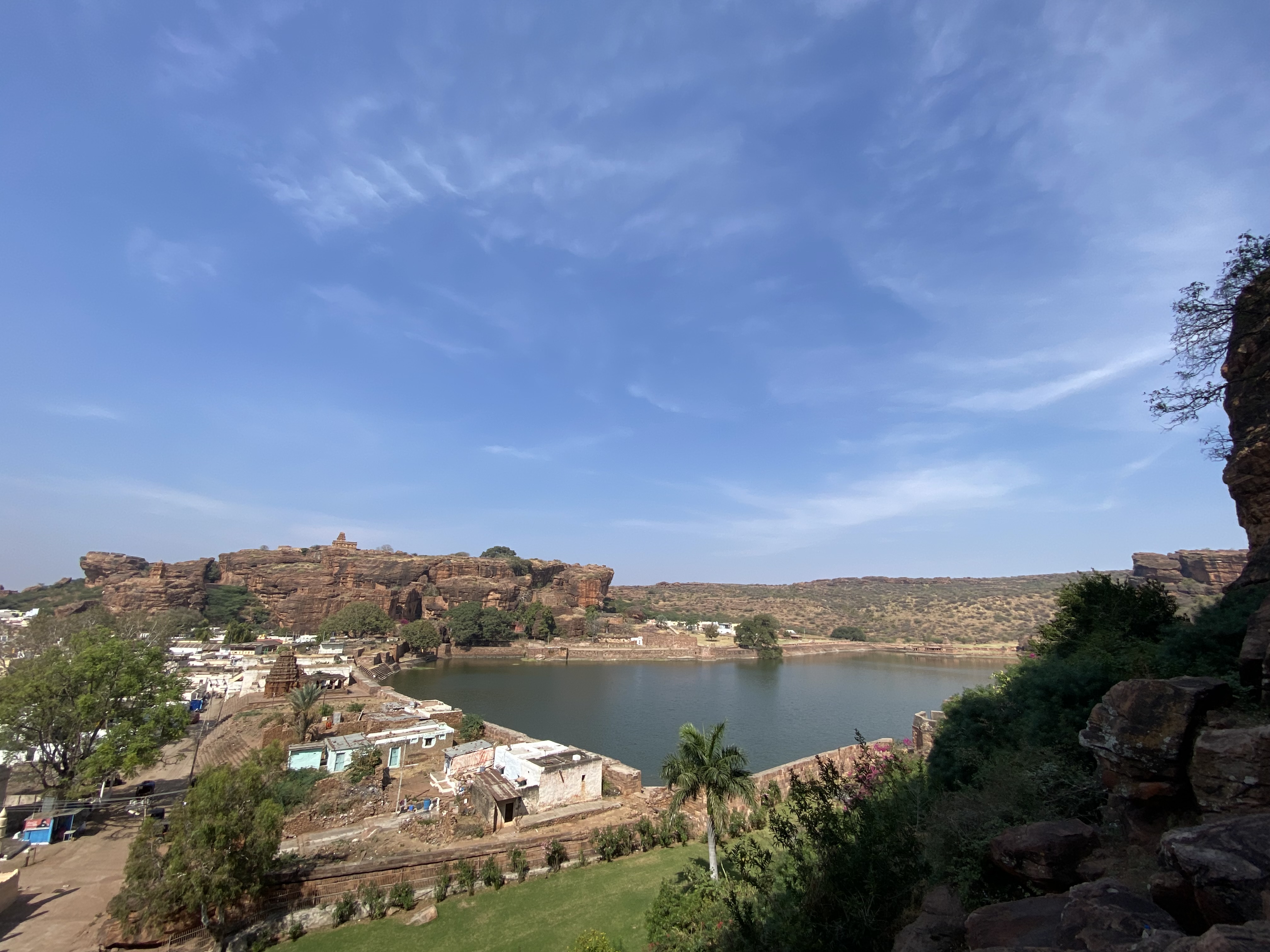


The first are the caves carved in the rock, dating between the sixth and seventh centuries, with beautiful and detailed carvings in the stone where different Buddhist, Hindu, and Jain representations stand out. The ascent is accompanied by the beauty of the women with their sarees, the colourful rocky landscape and the spontaneity of the children enjoying the place.
Below, it is possible to appreciate the set of Bhutanatha temples, Hindu temples dedicated to Lord Shiva and built between the seventh and eighth centuries, representing the Dravidian style typical of southern India. Its presence, the colour of the rocks and the contrast of the lake water make this place a special space to calm down and observe. Visitors and locals move around, worshipping, painting, washing clothes, fishing or wiping their feet; there, everything looks great.
The third element is the fortress, a gigantic structure, perfectly camouflaged with the environment and suitable to protect the royal palaces of this dynasty. When walking through it, we passed through the fresh canyons that are formed between the large rocks, which allowed us to enjoy the vegetation that has grown and enter the various levels of the fortress, with its temples and places of worship. From the top, it is possible to observe the network of alleys at the base of the mountain, with houses that pretend to be white, with flat roofs and, in some cases, evidently cultivated.
When we leave the temple, we find the weekly market, a collection of small stalls of fresh vegetables occupying the floor, with a freshness and wonderful colours that have the power to awaken the senses and generate infinite gratitude for those who cultivate the land.
We coincide with the festivities to celebrate the goddess Devi in the temple chosen in her honour. For a month, this goddess, as important in Hinduism as Shiva, Brahma and Vishnu, is worshipped. An extensive fair is organised around the temple with everything necessary to present the offerings and, in general, to attend to any need of daily life. We arrived at 1930h and everything was full and vibrant. We walked around the place from top to bottom, enjoying the images, the doors carved in wood with surprising mastery, the hand-painted brass trunks and the dark coffee blankets built with such delicacy that it is possible to use them as turbans.

Aihole presents an extensive set of temples that served as a centre of architectural experiment between the 5th and 8th centuries, with evidence of a great diversity of styles. Although they were originally dedicated to Vishnu, they were later transformed to honour Shiva. The gardens that surround the buildings give a spacious atmosphere in which to observe the details with curiosity and care, and enjoy the full experience. After noon, we had the pleasure of learning the preparation of Bakri, a flatbread made of millet, widely used by the locals as the main source of food. Under an intense heat, and working with two stoves fuelled by wood, the women knead, form, and cook the "tortillas" in a process that, seen from the outside, seems simple, but that, like all human trades, is full of mastery.


The temples of Pattadakal are impressive, built between the 7th and 8th centuries CE during the reign of the Rashtrakuta dynasty. In this complex, the Virupaksha Temple, erected in honor of Lord Shiva in 745 CE, stands out with its impressive tower (shikhara) and elaborate stone carvings depicting mythological scenes and everyday life. In front of its entrance, the beautiful and monumental statue of Nandi captures the attention of all visitors. Within the same complex, the Jain temple displays a more linear structure and is distinctive for its simplicity compared to its Dravidian counterparts.


At night we had the honour of having dinner with Vinod's family. We went out on his motorcycle, one at a time, to the oldest neighbourhoods of the centre. Vinod and his four brothers, along with their families, share the paternal house and live together with their mother; the father died a few years ago. We were greeted by the two older girls of two of the brothers, with the declamations they had made at school in the previous days. Then, they introduced us to the whole family: the brothers, their wives, their sons and daughters, and the mother. Subsequently, the older brother and his wife invited us to see the altar of the family, probably to pay our respects, and they welcomed us with drinks, blessings of light and gifts, and then took the corresponding photos. Afterwards, we enjoyed some delicious cooked vegetables, accompanied by bakri and rice.

Marce escaped from the main room to visit the women in the kitchen and learn their secrets in preparing bakri. So, she got down to work, and made her first bakri, the teachers were delighted with the result. Meanwhile, Alan in the living room convinced the older girl to organise his hair like hers, with two ponytails. Clearly, this seemed like an impossible activity to perform, but with a little support and a lot of laughter, he started the process. His uncle helped him and soon Alan had two pigtails on his head, while all the infants enjoyed the result with generous laughter.
We left there with a great sense of gratitude, inspired by the generosity of human beings and the inherent gift of being connected.
En español
Tomamos el tren para ir a Badami; pasaría a las 7:00 a.m. y estábamos en la estación a las 6:25, justo cuando el cielo comenzaba a iluminarse para darle paso al día. Esperamos en la plataforma 1, en el mismo lugar donde una vaca joven vaciaba sus intestinos después de levantarse del suelo. Aún hay personas durmiendo en un estupor sorprendente, y lentamente se va llenando el lugar con viajeros que van y vienen. Viajamos en un tren experimentado; los porta botellas originales ya no existen, pero han sido reemplazados por otros tejidos en pita plástica. Todo luce desgastado, pero todo está funcional. Así que disfrutamos nuestro recorrido con té, somosas y la paratha hecha por la madre de nuestros vecinos de silla.
En Badami, conocimos el proceso de compra de tiquetes en la taquilla del tren. Primero ofrecimos la información del tiquete que queríamos, luego llenamos un formulario con la misma información y, después, la persona que recibe el formulario vuelve a verificar la misma información. Esperamos entre otras personas que buscan hacer sus transacciones hasta que una mano espanta todas las voces como si fueran moscas y nos pasa el código QR para pagar. Las personas vuelven a llenar la taquilla y, tiempo después, la mano vuelve a espantarlos para entregarnos el tiquete. Lo único que sostiene el hilo en todas estas dinámicas es una mirada silenciosa.
Badami se siente caliente; son las 11:00 a.m. y ya está arriba de los 30 grados. Tomamos un tiempo al mediodía para comer algo y luego explorar la ciudad antigua. Un acantilado de piedra arenisca y granito sirve de contenedor para tres estructuras principales que, en forma de herradura, bordean el reservorio de agua principal y constituyen las evidencias arqueológicas de la dinastía Badami Chalukya. La dinastía Badami Chalukya gobernó entre los siglos VI y VIII y fue una de las más prominentes en la historia del sur de la India. Su capital fue Badami, Pattadakal su centro ceremonial y Aihole su centro religioso. Esta dinastía es conocida por su notable contribución al arte y la arquitectura. Los templos tallados en roca reflejan una fusión de estilos arquitectónicos hindúes y budistas. La dinastía jugó un papel importante en la propagación del hinduismo, fortaleciendo el culto a deidades como Shiva y Vishnu.
Las primeras son las cuevas labradas en la roca, que datan entre los siglos VI y VII, con hermosas y detalladas tallas en la piedra donde se destacan diferentes representaciones budistas, hindúes y jainistas. El ascenso está acompañado de la belleza de las mujeres con sus sarees, el colorido del paisaje rocoso y la espontaneidad de los infantes disfrutando del lugar.Abajo, es posible apreciar el conjunto de templos Bhutanatha, templos hindúes dedicados a Lord Shiva y construidos entre los siglos VII y VIII, representando el estilo dravidiano propio del sur de la India. Su presencia, el color de las rocas y el contraste del agua del lago hacen de este lugar un espacio especial para serenarse y observar. Visitantes y locales se mueven alrededor, adorando, pintando, lavando la ropa, pescando o limpiándose los pies; allí, todo parece grandioso.
El tercer elemento es la fortaleza, una estructura gigantesca, perfectamente mimetizada con el entorno y adecuada para proteger los palacios reales de esta dinastía. Al caminar por ella, se transita por los frescos cañones que se forman entre las grandes rocas, lo que permite disfrutar de la vegetación que ha crecido y acceder a los diversos niveles de la fortaleza, con sus templos y lugares de adoración. Desde la cima, es posible observar la red de callejuelas en la base de la montaña, con casas que pretenden ser blancas, de techos planos y, en algunos casos, evidentemente cultivadas.
Al dejar el templo, nos encontramos con el mercado semanal, una colección de pequeños puestos de verduras frescas ocupando el piso, con una frescura y colores maravillosos que tienen el poder de despertar los sentidos y generar infinita gratitud por quienes cultivan la tierra. Coincidimos con las festividades para celebrar a la diosa Devi en el templo elegido en su honor. Durante un mes se rinde culto a esta diosa, tan importante en el hinduismo como Shiva, Brahma y Vishnu. Se organiza una extensa feria alrededor del templo con todo lo necesario para presentar las ofrendas y, en general, para atender cualquier necesidad de la vida cotidiana. Llegamos a las 7:30 y todo estaba lleno y vibrante. Caminamos por el lugar de arriba a abajo, disfrutando de las imágenes, las puertas talladas en madera con una maestría sorprendente, los baúles de latón pintados a mano y las cobijas de café oscuro construidas con tal delicadeza que es posible usarlas como turbantes.
Aihole presenta un extenso conjunto de templos que sirvieron como centro de experimentación arquitectónica entre los siglos V y VIII, con evidencia de gran diversidad de estilos. Aunque originalmente fueron dedicados a Vishnu, luego fueron transformados para honrar a Shiva. Los jardines que rodean las edificaciones confieren un ambiente espacioso para observar con curiosidad y cuidado los detalles, y disfrutar la experiencia completa. Pasado el mediodía, tuvimos el placer de aprender la elaboración de Bakri, un pan plano hecho de millo, muy utilizado por los locales como principal fuente de alimento. Bajo un calor intenso, y trabajando con dos fogones alimentados por leña, las mujeres amasan, forman y cocinan las tortillas en un proceso que, visto desde afuera, parece simple, pero que, como todos los oficios humanos, está lleno de maestría.
En la noche tuvimos el honor de cenar con la familia de Vinod. Salimos en su moto, uno a la vez, hacia los barrios más antiguos del centro. Vinod y sus cuatro hermanos, junto con sus familias, comparten la casa paterna y viven juntos con su madre; el padre falleció hace algunos años. Fuimos recibidos por las dos niñas mayores de dos de los hermanos, con las declamaciones que habían realizado en la escuela en los días anteriores. Luego, nos presentaron a toda la familia: los hermanos, sus esposas, sus hijos e hijas, y la mamá. Posteriormente, el hermano mayor y su esposa nos invitaron a conocer el altar de la familia, seguramente para rendir nuestros respetos, y nos dieron la bienvenida con sahumerios, bendiciones de luz y obsequios, para luego tomar las fotos correspondientes. Después, disfrutamos de unos deliciosos vegetales cocidos, acompañados de bakri y arroz.
Marce escapó de la sala principal para visitar a las mujeres en la cocina y aprender sus secretos para preparar bakri. Así que, se puso manos a la obra, he hizo mi primer bakri, las profesoras estaban encantadas con el resultado. Mientras tanto, Alan en la sala convencía a la niña mayor de organizar su pelo como el de ella, con dos coletas. Claramente, esto le parecía una actividad imposible de realizar, pero con un poco de apoyo y muchas risas, inició el proceso. Su tío le ayudó y pronto Alan tenía dos coletas en la cabeza, mientras todos los infantes disfrutaban el resultado con risas generosas. Salimos de allí con un gran sentido de gratitud, inspirados por la generosidad de los seres humanos y el regalo inherente que implica estar conectados.


It would have been nice to Alan photo with 2 pony tails for the tecord., lol
ReplyDelete