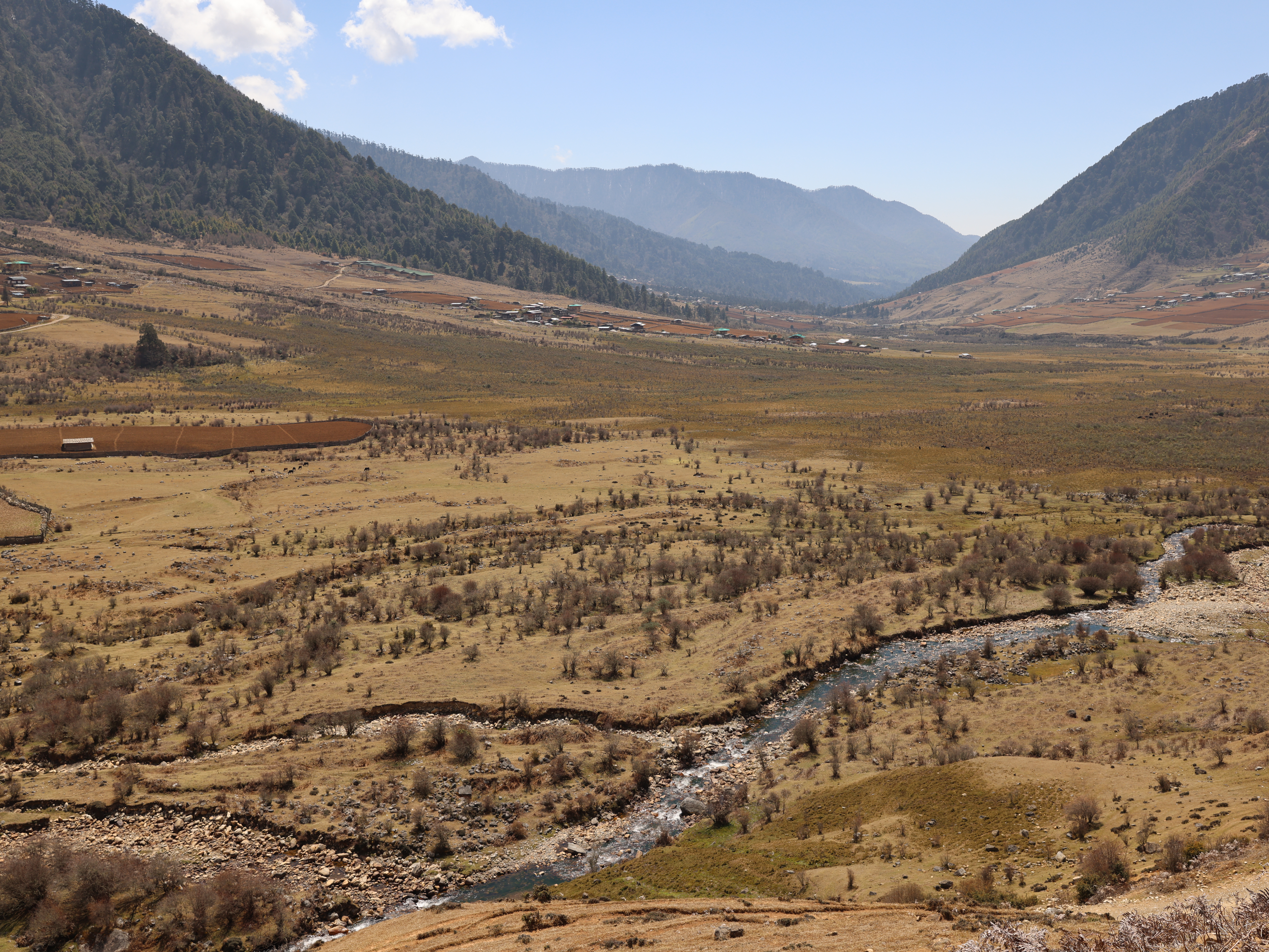
Phobjikha Valley

placer.


It took us two days to reach the valley, and on the route we found a conical mountain that emerged in the middle of the confluence of two mountain ranges, creating a mysterious landscape. The forest that inhabits the mountains is leafy, and it is possible to appreciate the silhouettes of the fir trees at the top. The story tells that this mountain is the home of demons, and for this reason, in the 18th century, the Chendebji Chorten temple was built on the demon's body when it was defeated, to prevent it from harassing the inhabitants of the region again. The stupa is built in Nepalese style and is accompanied by an extensive prayer wall with several ceremonial stones; the place is beautiful and the myth feeds the imagination.


When we crossed the Lawala pass, the cold and wind prevented any exploration, being strong enough to reject the tea. Thus, we continued to the entrance of the valley, where the rays of the afternoon sun sheltered us enough to take a picture of the stupa and continue. After two days of travel, rain and cold, and still with a little flu, it was a pleasure to arrive, enjoy the shelter of the fire and contemplate the sunset from the window.


We started the day early, since a very white light touched our eyelids. The night before it had begun to snow, and the landscape, far from the green of the forest, the mustard of the grass and the coffee of the lands prepared for cultivation, was covered with a delicate white mantle that embellished the view with nostalgia.


Phobjikha became an ideal place to walk in all directions, revealing new landscapes, vegetation and birds. To the north, we were surprised by a coniferous forest, with trails of snow and flowers. In the plains of the valley, the river, the yaks and the birds of the bank were added to the scenes of cultivation and use of the land; to the south, the landscape extended with endless mountains, villages dedicated to livestock and encounters with unknown canyons and their high-flying birds.


This valley stands out for receiving a significant population of cranes. It is a protected flood site, which has allowed a growing number of black-necked cranes to reside during the winter. It is normal for the cranes to return to the north towards the end of February and the first half of March, so we were aware of the limited probability of finding them. In the valley there is a visitor centre with an informative exhibition about the habitat and its inhabitants, including the migration of cranes, as well as an observation platform and an enclosure that houses two cranes that were injured and rehabilitated, but that cannot live in wild conditions.


We spent much of the afternoon at the visitor centre, but it was not possible to see the cranes. We explored one of the nearby monasteries and, on our return, Alan, as always persevering, scanned the valley again with his binoculars and saw two specimens. We stopped and discovered that there were five: two adults and three juveniles, the last cranes of the migration, waiting for the maturation of the chicks to take flight. They walked to the north of the valley calmly, exploring the food menu available at sunset.


We took a compassionate meditation class in one of the monasteries in the area. The lama explained to us in a simple and direct way the key elements of the process in its three stages. We practised together, and there, in that unknown place of consciousness, a lasting connection was established.


The weather in the valley ended with a surprising sighting of a Himalayan griffon; a huge group cleaned the carcass of an animal that died the night before with admirable efficiency, while the crows were still waiting for their turn to approach the remains.


The weather in Phobjikha was full of space, beauty and surprises. It is a place to embrace tranquillity, breathe and appreciate. A real pleasure.


Alan y Marce


En español

Nos tomó dos días llegar al valle, y en la ruta nos encontramos con una montaña cónica que emergía en medio de la confluencia de dos cadenas montañosas, creando un paisaje misterioso. El bosque que habita en las montañas es frondoso, y es posible apreciar las siluetas de los abetos en la cima. La historia cuenta que esta montaña es el hogar de demonios, y por ello, en el siglo XVIII, se construyó el templo Chendebji Chorten sobre el cuerpo del demonio cuando fue vencido, para evitar que volviera a hostigar a los habitantes de la región. La estupa está construida en estilo nepalí y se acompaña de un extenso muro de oración con varias piedras ceremoniales; el lugar es hermoso y el mito alimenta la imaginación.


Cuando cruzamos el paso de Lawala, el frío y el viento impidieron cualquier exploración, siendo lo suficientemente fuertes como para rechazar el té. Así, continuamos hasta la entrada del valle, donde los rayos del sol de la tarde nos abrigaron lo suficiente como para hacer una foto de la estupa y proseguir. Después de dos días de viaje, lluvia y frío, y aún con un poco de gripe, fue un placer llegar, disfrutar del abrigo del fuego y contemplar el atardecer desde la ventana.


Comenzamos el día temprano, ya que una luz muy blanca nos tocó los párpados. La noche anterior había comenzado a nevar, y el paisaje, lejos del verde del bosque, el mostaza del pasto y el café de las tierras preparadas para el cultivo, estaba cubierto con un delicado manto blanco que embellecía la vista con nostalgia.


Phobjika se convirtió en un lugar ideal para caminar en todas direcciones, revelando nuevos paisajes, vegetación y aves. Al norte, nos sorprendió un bosque de coníferas, con rastros de nieve y flores. En las planicies del valle, el río, los yaks y las aves de la ribera se sumaban a las escenas de cultivo y uso de la tierra; hacia el sur, el paisaje se extendía con interminables montañas, poblados dedicados a la ganadería y encuentros con cañones desconocidos y sus aves de vuelo alto.


Este valle se destaca por recibir una población significativa de grullas. Es un lugar inundable protegido, lo que ha permitido que un número creciente de grullas de cuello negro puedan residir durante el invierno. Es normal que las grullas regresen al norte hacia finales de febrero y la primera mitad de marzo, por lo que éramos conscientes de la probabilidad limitada de encontrarlas. En el valle hay un centro de visitantes con una exhibición informativa sobre el hábitat y sus pobladores, incluyendo la migración de grullas, así como una plataforma de observación y un recinto que alberga a dos grullas que fueron heridas y rehabilitadas, pero que no pueden vivir en condiciones silvestres.


Pasamos buena parte de la tarde en el centro de visitantes, pero no fue posible avistar a las grullas. Exploramos uno de los monasterios cercanos y, a nuestro regreso, Alan, como siempre perseverante, volvió a escanear el valle con sus binoculares y avistó dos ejemplares. Nos detuvimos y descubrimos que había cinco: dos adultos y tres juveniles, las últimas grullas de la migración, esperando la maduración de los polluelos para emprender el vuelo. Caminaron hacia el norte del valle con calma, explorando el menú de comida disponible al atardecer.


Tomamos una clase de meditación compasiva en uno de los monasterios de la zona. El lama nos explicó de forma sencilla y directa los elementos clave del proceso en sus tres etapas. Practicamos juntos, y allí, en ese lugar incógnita de la conciencia, se estableció una conexión duradera.


El tiempo en el valle terminó con un avistamiento sorprendente de un griffon himalayo; un grupo inmenso limpiaba la carcasa de un animal fallecido la noche anterior con una eficiencia admirable, mientras los cuervos aún esperaban su turno para acercarse a los restos.


El tiempo en Phobjikha estuvo lleno de espacio, belleza y sorpresas. Es un lugar para abrazar la tranquilidad, respirar y apreciar. Todo un placer.


Exploring the east: Mongar and Lhuntse

 We left Bumthang aware that it would be a long day crossing the mountains to the east. The ascent began very quickly; we took a secondary route with very little traffic and beautiful views. Upon reaching the highest part, we leave the car to explore the surroundings and enjoy the silence, the remains of snow that accompany the peaks and the thick and green fir forest that covers the rocky mountains as far as the eye can see. Right there, on the route and among the rocks, hundreds of mini stupas have been arranged as an offering for the protection and blessing of travellers, as well as to honour the land and the territory. Before being offered, the mini stupas, created in clay or plaster and sometimes including relics or ashes of monks, are blessed by a priest; the mantras are placed inside and, only after this, often in a communal way, they are arranged in the desired place with a sacred character.

Coincidentally, in Ura, a small town to the east, a mask festival was held. Moving through the houses decorated with pennants, we arrived at the local temple where the music was already present. The residents were sitting with discipline around the main courtyard enjoying the spectacle. On this occasion, the ceremonial dances, frequently performed by the monks, alternated with the folk dances by the women of the place, while boys and girls appropriated the bosses, dancing freely between games and races. The day was bright and, despite the cool winds, the sun brought life to every turn.


The route to Mongar is again a mountain road, with deep canyons, prolific forests and waterfalls. In the descent, the songs of the birds accompanied our walking moments and the unforgettable teas of the route. Mongar is the gateway to the east district and is located at 1600 metres; its mild climate gives it colour and melody, making it easy to distract yourself at each step with new movements between the thickets, new songs or new elements of the landscape.


Following the Kuri Chou River canyon, we arrived at the Lhuntse district, known for the richness of its fabrics. The river winds through a narrow canyon interconnected by some suspension bridges; its waters are transparent, cold and flow at an amazing speed. It is a leisurely route that allowed us to appreciate monkeys and birds with tranquillity, as well as collect blue pine needles to weave a basket.


On the east slopes is Khoma, a village recognised for its excellence in silk weaving, especially in Kiras and Ghos. Silk is produced in the south and, on some occasions, is dyed locally with natural products. Women knit between 8 and 10 hours a day, advancing between 5 and 6 cm; each row of fabric demands deep attention and the knotted thread by thread of the geometric design that is being created. Thus, the elaboration of a line in an experienced weavener can take up to 10 minutes.

In this valley, to the northwest, there are two key attractions in the order of Bhutan: the Dzong and the statue of Guru Rimponche. The Dzong of Lhuentse dates back to 1540; its history includes the capture of a sacred statue called Shepakmey by a fisherman, which, after several demonstrations, landed on the roof of the Dzong. In 1693, the monastic body and the educational system were established to benefit the Dharma in the eastern regions.


On the other hand, the gigantic sculpture of Guru Rimponche stands out for its height of 52.7 metres; its face is plated in gold and its richness is reflected in the temples inside and in the 108 stupas that surround it, all in a beautiful landscape. This statue was built between 2008 and 2015 and was consecrated following a prophecy intended to bring peace, prosperity and happiness to the universe, as well as to avoid war, hunger and natural disasters. Often, the temples cannot be photographed, however this time they did not allow it, so we leave you some photos for your enjoyment.


Alan y marce


En español


Salimos de Bumthang conscientes de que sería un día largo cruzando las montañas hacia el este. Muy rápidamente comenzó el ascenso; tomamos una ruta secundaria con muy poco tráfico y vistas preciosas. Al llegar a la parte más alta, dejamos el carro para explorar el entorno y disfrutar del silencio, los restos de nieve que acompañan los picos y el bosque de abeto tupido y verde que cubre las montañas rocosas hasta donde alcanza la vista. Justo allí, en la ruta y entre las rocas, cientos de mini estupas han sido dispuestas como ofrenda para la protección y bendición de los viajeros, así como para honrar la tierra y el territorio. Antes de ser ofrecidas, las mini estupas, creadas en barro o yeso y a veces incluyendo reliquias o cenizas de monjes, son bendecidas por un sacerdote; los mantras se colocan en su interior y, solo después de esto, frecuentemente de manera comunitaria, se disponen en el lugar deseado con un carácter sagrado.

Por coincidencia, en Ura, una pequeña localidad al este, se celebraba un festival de máscaras. Moviéndonos entre las casas decoradas con banderines, llegamos al templo local donde la música ya hacía su presencia. Los pobladores estaban sentados con disciplina alrededor del patio principal disfrutando del espectáculo. En esta ocasión, las danzas ceremoniales, frecuentemente ejecutadas por los monjes, se alternaban con las danzas folclóricas a cargo de las mujeres del lugar, mientras niños y niñas se apropiaban de los patrones, danzando en libertad entre juegos y carreras. El día estaba luminoso y, a pesar de los vientos frescos, el sol aportaba vida a cada giro.

La ruta a Mongar es nuevamente un camino de montaña, con cañones profundos, bosques prolíficos y cascadas. En el descenso, los cantos de los pájaros acompañaron nuestros momentos de caminata y los inolvidables tés del recorrido. Mongar es la puerta de entrada al distrito del este y se ubica a 1600 metros; su clima templado le da color y melodía, haciendo que sea fácil distraerse en cada paso con nuevos movimientos entre los matorrales, nuevos cantos o nuevos elementos del paisaje.

Siguiendo el cañón del río Kuri Chou, llegamos al distrito de Lhuntse, conocido por la riqueza de sus tejidos. El río serpentea por un cañón estrecho interconectado por algunos puentes colgantes; sus aguas son transparentes, frías y fluyen a una velocidad asombrosa. Es una ruta pausada que nos permitió apreciar monos y pájaros con tranquilidad, así como recolectar agujas de pino azul para tejer una canasta.


En las laderas del este se encuentra Khoma, una aldea reconocida por su excelencia en el tejido de seda, especialmente en Kiras y Ghos. La seda se produce en el sur y, en algunas ocasiones, se tiñe localmente con productos naturales. Las mujeres tejen entre 8 y 10 horas al día, avanzando entre 5 y 6 cm; cada hilera de tejido demanda profunda atención y el anudado hilo por hilo del diseño geométrico que se está creando. Así, la elaboración de una línea en una tejedora experimentada puede demorar hasta 10 minutos.


En este valle, hacia el noroeste, se encuentran dos atracciones clave en el ordenamiento de Bután: el Dzong y la estatua de Gurú Rimponche. El Dzong de Lhuentse data de 1540; su historia incluye la captura de una estatua sagrada llamada Shepakmey por un pescador, la cual, tras varias manifestaciones, se posó en el techo del Dzong. En 1693, se estableció el cuerpo monástico y el sistema educativo para beneficiar el Dharma en las regiones orientales. 


Por otro lado, la escultura gigantesca de Gurú Rimponche destaca por su altura de 52.7 metros; su cara está enchapada en oro y su riqueza se refleja en los templos en su interior y en las 108 estupas que la circundan, todo ello en un hermoso paisaje. Esta estatua fue construida entre 2008 y 2015 y fue consagrada siguiendo una profecía destinada a traer paz, prosperidad y felicidad al universo, así como para evitar la guerra, el hambre y las catástrofes naturales. Frecuentemente, los templos no pueden ser fotografiados, sin embargo está vez no lo permitieron, así que les dejamos  algunas fotos para su disfrute. 


Alan y Marce


To the valleys of the centre / A los Valles del Centro


 We opened our eyes and the largest of the fortresses of Bhutan, Trongsa, was in front of us, wrapped in the morning fog. The clouds move quickly and, in a matter of seconds, the image goes from sharp and complete to fragmented, completely covered and open again; it is a good metaphor for the impermanence and constant transformation of this reality that we are.

We walk along the road, enjoying the landscape of the river canyon, while the little birds sing around us and the warm rays of the sun evoke a delicious hug. We arrived at the fortress, where a Dharma teaching session was being held. The monks and the community were gathered, listening to the teacher, singing his mantras and generously sharing butter tea and crushed corn.


The area was covered with blue pine leaves for ease of use by the villagers, while the monks were sitting on their cushions, which were covered with woollen mats. In front of the temple, a gigantic altar of offerings continued to grow with each new visitor, and behind the entire congregation, in huge pots, food was prepared for all those attending the meeting.


The fortress is imposing, looking at the valley. In ancient times, trade between the east and west forced to pass through this fortress, which allowed the collection of taxes. Its structure is fascinating; multiple levels and components create a unique architectural complex that invites exploration. It is a vibrant place in all its aspects: a monastery that houses a significant group of monks in formation, temples in daily use and an active administration of the place.


The decoration shows the experience in terms of the wear and tear of everyday history, without being repainted for the safe of appearance. However, woodwork and painting stand out for their detail and complexity.


In the city, a new construction rises in the centre: it is the new market square, a strategy of the kingdom to stimulate agricultural work and offer farmers the best conditions to market their products. While the square is finished, the market is still on the street, voluptuous and provocative. Fresh, brightly coloured and highly diverse foods are a pleasure for the senses and a delight when enjoying meals every day.


On the way to Bhumtang, we could calmly see a beautiful flock of yaks. Then we ascend to the passage at 3,500 metres, at the Yatong summit, which constitutes the boundary between the two districts. There, between the wind and the cold, we stop to have our "High Tea".


The descent was quick and took us to the first town of Bumthang, Shuri, a place dedicated to agriculture and livestock. Their houses have different constructive details, with large wooden fences, stables and large clusters of hay to feed the animals. On the route, hairy cows are warmed in the sun, while the blue pine forests serve as a background.


We visited one of the local textile places, where we found a beautiful collection of wool, cotton and silk fabrics, with intricate designs. The Kiras were a true beauty: two metres of woven fabric 1.50 wide, creating a beautiful set of shapes and patterns that make up the traditional costume of women.


Bumthang is home to two very important temples in the Buddhist tradition of Bhutan. On the one hand, there is the temple of Guru Rimpoche, built in the cave that he used to meditate, where it is believed that his body was carved from the rock. We arrived at the place just when the monks began their prayer, and listening to their voices and mantras, with low tones and varied rhythms, was an experience that connected us with the present. Initially, the temple was a small construction, but over time two buildings have been added that offer space for the residence and training of the monks.


Just a 30-minute walk away, you will find another jewel: the oldest temple in Bhutan. Its construction feels old, preceded by a stupa made of rock edges, some of which are carved and painted. The place is accessed by a majestic gate, and around it, the prayer wheels accompany the walkers with their soft noise when rolling. In this temple, several stupas surround the central building, each with a different colour—yellow, red, black and white—serving as protection of the four cardinal points. These forms of protection accompany the paintings of the four protective kings that we also find in the anterooms of the temples.


Near Bumthang is the Lupra Valley. On the route, we visited a convent of Buddhist nuns, preceded by a canyon of crystal clear waters that is venerated for housing a relic of high importance in local religious life, known as the "lake on fire". Upon arriving at the monastery, we coincided again with the moment of prayer; this time, the experience was different. We were received as observers and we had a space to sit and enjoy the ceremony. The prayer was interwoven with songs, hand drums and mantras in beautiful harmony, which raised our spirit and made us feel connected to everything. It was a very different experience from the one we had with the monks, not because we were not welcome, but because of the closeness and brightness of the environment, which created an expansive and unique moment.


We had lunch by the river, sitting on the grass and surrounded by crows and dogs. While exploring the other side of the river, the others observed a game of archery, the national sport practised throughout the country. We saw two formats: the traditional bow and the composite bow, both with a white located 140 metres away, twice the distance of the Olympic competitions. In both modalities, two teams of up to 15 players seek to reach 25 points. The count is complex, since it is added and subtracted, which makes the games last a day or more, especially in the traditional format with wooden bows and bamboo arrows. Social and symbolic acts are added to the sporting activity: every time a player reaches the goal, the entire team dances on both sides of the court, demonstrating their unity and praising their success. Both teams try to influence the attention of the player on duty. When a team finishes its round, it counts the points and each player who hits receives a silk that hangs from his belt, filling his gho with colour. The contest is accompanied by rice wine, which is consumed by both players and spectators. This community received us with love and shared with us the wine, tea, toasted rice and cookies.


We close the day between heat and rain, visiting Ogyen Palace, a perfect sample of the architecture of Bhutan in the times of principalities and aristocrats in the 19th century. This place has been in the same family and became a museum after, in the 1960s, a land tenure reform was established that allowed all families to access an equal amount of land, eliminating the dominion of the aristocrats. The house reflects the splendour of these families: the first two floors are dedicated to grain storage, which at the time was the measure of wealth; the third floor is intended for the family room, and the fourth floor houses religious, spiritual and ceremonial activities. The house has a wide collection of objects that recreate the life of that time.


Alan y Marce


En español

Abrimos los ojos y la más grande de las fortalezas de Bután estaba frente a nosotros, la fortaleza de Trongsa, envuelta en la neblina de la mañana. Las nubes se mueven rápidamente y, en cuestión de segundos, la imagen pasa de nítida y completa a fragmentada, completamente cubierta y nuevamente abierta; es una buena metáfora de la impermanencia y la constante transformación de esta realidad que somos.


Caminamos por la carretera, disfrutando del paisaje del cañón del río, mientras los pequeños pájaros cantan a nuestro alrededor y los rayos tibios del sol evocan un delicioso abrazo. Llegamos a la fortaleza, donde se estaba llevando a cabo una sesión de enseñanza de Dharma. Los monjes y la comunidad estaban reunidos, escuchando al maestro, cantando sus mantras y compartiendo generosamente té de mantequilla y maíz aplastado.


El área estaba cubierta de hojas de pino azul para facilitar el uso por parte de los pobladores, mientras los monjes estaban sentados en sus cojines, que estaban cubiertos con tapetes de lana. Al frente del templo, un altar de ofrendas gigantesco seguía creciendo con cada nuevo visitante, y detrás de toda la congregación, en ollas enormes, se preparaba la comida para todos los asistentes a la reunión.

La fortaleza se presenta imponente, mirando al valle. En tiempos antiguos, el comercio entre el este y el oeste obligaba a pasar por esta fortaleza, lo que permitía el recaudo de impuestos. Su estructura es fascinante; múltiples niveles y componentes crean un complejo arquitectónico único que invita a la exploración. Es un lugar vibrante en todos sus aspectos: un monasterio que alberga a un grupo significativo de monjes en formación, templos en uso diario y una administración activa del lugar.


 La decoración evidencia la experiencia en términos del desgaste de la historia cotidiana, sin ser repintada por el bien de la apariencia. Sin embargo, el trabajo en madera y la pintura destacan por su detalle y complejidad.  


En la ciudad, una nueva construcción se eleva en el centro: es la nueva plaza de mercado, una estrategia del reino para estimular el trabajo agrícola y ofrecer a los agricultores las mejores condiciones para comercializar sus productos. Mientras la plaza se termina, el mercado sigue en la calle, voluptuoso y provocador. Los alimentos frescos, de colores vivos y altamente diversos son un placer para los sentidos y una delicia al momento de disfrutar de las comidas cada día.


En ruta a Bhumtang, pudimos avistar con calma un hermoso rebaño de yaks. Luego ascendimos al paso a 3,500 metros, en la cima Yatong, que constituye el límite entre los dos distritos. Allí, entre el viento y el frío, paramos a tomar nuestro "High Tea".


El descenso fue rápido y nos llevó al primer poblado de Bumthang, Shuri, un lugar dedicado a la agricultura y la ganadería. Sus casas presentan detalles constructivos diferentes, con grandes cercas de madera, establos y amplios cúmulos de heno para alimentar a los animales. En la ruta, vacas peludas se calientan al sol, mientras los bosques de pinos azules sirven de fondo.


Visitamos uno de los lugares de textiles locales, donde encontramos una hermosa colección de tejidos en lana, algodón y seda, con intrincados diseños. Las Kiras fueron una verdadera belleza: dos metros de tela tejida de 1,50 de ancho, creando un conjunto precioso de formas y patrones que constituyen el traje tradicional de las mujeres. 


Bumthang alberga dos templos muy importantes en la tradición budista de Bután. Por un lado, está el templo de Guru Rimpoche, construido en la cueva que él utilizó para meditar, donde se cree que su cuerpo fue tallado en la roca. Llegamos al lugar justo cuando los monjes iniciaban su oración, y escuchar sus voces y mantras, con tonos bajos y ritmos variados, fue una experiencia que nos conectó con el presente. Inicialmente, el templo fue una construcción pequeña, pero con el paso del tiempo se han añadido dos edificios que ofrecen espacio para la residencia y el entrenamiento de los monjes.


A solo 30 minutos caminando, se encuentra otra joya: el templo más antiguo de Bután. Su construcción se siente añeja, precedida por una estupa hecha de cantos de roca, algunas de las cuales están talladas y pintadas. Se accede al lugar por un portón majestuoso, y a su alrededor, las ruedas de oración acompañan a los caminantes con su suave ruido al rodar. En este templo, diversas estupas rodean la construcción central, cada una con un color diferente—amarillo, rojo, negro y blanco—serviendo como protección de los cuatro puntos cardinales. Estas formas de protección acompañan las pinturas de los cuatro reyes protectores que también encontramos en las antesalas de los templos.


Cerca de Bumthang se encuentra el valle de Lupra. En la ruta, visitamos un convento de monjas budistas, precedido por un cañón de aguas cristalinas que es venerado por albergar una reliquia de alta importancia en la vida religiosa local, conocida como el "lago en llamas". Al llegar al monasterio, coincidimos nuevamente con el momento de oración; esta vez, la experiencia fue diferente. Nos recibieron como observadores y tuvimos un espacio para sentarnos y disfrutar de la ceremonia. La oración se entretejió con cantos, tambores de mano y mantras en hermosa armonía, lo que elevó nuestro espíritu y nos hizo sentir conectados con todo. Fue una experiencia muy distinta a la que tuvimos con los monjes, no porque no fuéramos bienvenidos, sino por la cercanía y luminosidad del ambiente, que crearon un momento expansivo y singular.


Almorzamos junto al río, sentados sobre el pasto y rodeados de cuervos y perros. Mientras exploraba el otro lado del río, los demás observaron una partida de arquería, el deporte nacional practicado en todo el país. Vimos dos formatos: el arco tradicional y el arco compuesto, ambos con un blanco situado a 140 metros de distancia, el doble de la distancia de las competencias olímpicas. En ambas modalidades, dos equipos de hasta 15 jugadores buscan alcanzar 25 puntos. El conteo es complejo, ya que se suma y se resta, lo que hace que las partidas duren un día o más, especialmente en el formato tradicional con arcos de madera y flechas de bambú. A la actividad deportiva se suman actos sociales y simbólicos: cada vez que un jugador alcanza el objetivo, el equipo completo danza a ambos lados de la cancha, demostrando su unidad y elogiando su éxito, Ambos equipos intentan influir en la atención del jugador de turno. Cuando un equipo termina su ronda, contabiliza los puntos y cada jugador que acierta recibe una seda que cuelga de su cinto, llenando de color su gho. El certamen se acompaña con vino de arroz, que es consumido tanto por jugadores como por espectadores. Esta comunidad nos recibió con amor y compartió con nosotros el vino, el té, el arroz tostado y las galletas.


Cerramos el día entre calor y lluvia, visitando Ogyen Palace, una muestra perfecta de la arquitectura de Bután en los tiempos de principados y aristócratas en el siglo XIX. Este lugar ha estado en la misma familia y se convirtió en un museo después de que, en la década de los sesentas, se estableciera una reforma de la tenencia de la tierra que permitió a todas las familias acceder a una cantidad igual de tierra, eliminando el dominio de los aristócratas. La casa refleja el esplendor de estas familias: los primeros dos pisos están dedicados al almacenamiento de grano, que en su momento fue la medida de la riqueza; el tercer piso está destinado a la habitación familiar, y el cuarto piso alberga actividades religiosas, espirituales y ceremoniales. La casa cuenta con una amplia colección de objetos que recrean la vida de esa época.



Gasa, the highlands of the northwest. / Gasa las tierras altas del noroccidente

We took the northern route to enter the forests of northwestern Bhutan, and soon began to stop to spot birds and admire the beauties of the place. The route is a constant ascent that allows you to move from the land cultivated at the base to the pine forests in the middle lands and to the oldest fir forests in the heights. With each curve, a new element of the landscape appears, and surprise inhabits both consciousness and stomach.

The rural houses preserve the design elements of the Bhutanese architecture and are complemented by other buildings typical of the agricultural world. They are surrounded by crop terraces that create a beautiful mosaic in green and brown tones, provoking the curiosity of those who observe them. Examples of Bhutanese traditions can also be seen in the technique of fixing ceilings: stones supported by wooden crossbars.


We made a stop in a small community along the route, where we tasted momos and ramel accompanied by local tea, toasted rice and rice drink called ara. This drink is consumed at weddings and social events in Bhutan; it is distilled in a simple system of copper vessels and stored in wooden or horn containers decorated with silver.


After a day on the road and multiple stops, we arrived at the famous hot springs of Gasa. We went down to the pool area, which consists of two oval structures with four separate pools of water for men and women. We changed in the defined area, open to the mountain, we washed our bodies under the available hose and entered the warm and hugging water.


In the women's area, the place was full; in the first two pools there was no space available, so Marce entered the third and gave herself to rest. She smiled at the local women, all enjoying their rest, submerged up to the neck, with their strong hands massaging their fatigued joints and harmoniously waiting for their turn to be under the hot water jet. In the men's pool, Alan, Nawang, and Kadu talked to the district leader about the place, its growing history, and the reconstruction process after successive avalanches that have destroyed the infrastructure.


We arrived at our accommodation in the dark and the rain. We went down a slippery route to reach the entrance staircase, left our shoes in the portal along with our bath clothes, and entered the room. It was a large space, covered with mats to sit around a traditional stove in the centre, which warmed the atmosphere and invited to stay close.


The family that hosted us is made up of the couple and their daughters of 10 and 3 years old. During the winter, they share their home with another family of mountain dwellers who seek refuge away from the cold and snow of the peaks. The food was delicious; we can't forget the sweet and sour flavour of the cucumber produced in their garden, as well as the smoky flavour of their stewed chillies. The younger daughter fell into a deep sleep after her friend left, while the older held an active and carefree conversation with us about her preferences and our travels.


After a relaxing night, wrapped in blankets to avoid the cold, we started the day with light and without rain. Unfortunately, the mountains were still covered by clouds and we could not appreciate their beautiful topography that could barely be glimpsed. Visitors from the north were preparing to return home, and their little daughter moved behind them with anxiety, as if she was afraid of being left. Kindly, they allowed me to photograph them to appreciate the uniqueness of their wardrobe.


The Dzong de Gasa is a majestic fortress with circular walls that stands out both for its impressive architecture and for its panoramic location. Built in the 17th century, this dzong fulfils administrative functions and is an important religious centre for the local community. Its design combines traditional Bhutanese elements with Tibetan influences, sporting robust walls and elaborately carved ceilings. Surrounded by a lush natural landscape, the dzong stands as a symbol of peace and protection. From its balconies and levels, visitors can enjoy breathtaking views of the nearby mountains; the vibrant play of colours of the prayer flags and the simple access roads contribute to its serene atmosphere. When visiting the temple, we found the monks preparing ornaments with flour and butter, which are then decorated with colours and serve as offerings, as well as garlands with sacred seeds that are installed around the temple.


We returned the same way and delighted ourselves again with the surprises of each curve. 


Alan y Marce


En español


Tomamos la ruta norte para adentrarnos en los bosques del noroeste de Bután, y pronto comenzamos a detenernos para avistar pájaros y admirar las bellezas del lugar. La ruta es un constante ascenso que permite pasar de las tierras cultivadas en la base a los bosques de pino en las tierras medias y a los más antiguos bosques de abeto en las alturas. Con cada curva, un nuevo elemento del paisaje aparece, y la sorpresa habita tanto en la conciencia como en el estómago.

Las casas rurales preservan los elementos constructivos de la arquitectura butanesa y se complementan con otras edificaciones propias del mundo agrícola. Están rodeadas de terrazas de cultivos que crean un hermoso mosaico en tonos verdes y marrones, provocando la curiosidad de quienes las observan. Asimismo, se pueden ver ejemplos de las tradiciones butanesas en la técnica de fijar los techos: piedras sostenidas por travesaños de madera.

Hicimos una parada en una pequeña comunidad a lo largo de la ruta, donde probamos momos y ramel acompañados de té local, arroz tostado y bebida de arroz llamada ara. Esta bebida se consume en bodas y eventos sociales en Bután; se destila en un sencillo sistema de vasijas de cobre y se almacena en contenedores de madera o cuerno decorados con plata.

Tras un día de camino y múltiples paradas, llegamos a las famosas aguas termales de Gasa. Bajamos a la zona de piscinas, que constan de dos estructuras ovales con cuatro pozas de agua separadas para hombres y mujeres. Nos cambiamos en el área definida, abierta hacia la montaña, nos lavamos el cuerpo bajo la manguera disponible y entramos en el agua cálida y abrazadora.

En la zona de mujeres, el lugar estaba lleno; en las dos primeras pozas no había espacio disponible, así que entré en la tercera y me entregué al reposo. Sonreí a las mujeres locales, todas disfrutando de su descanso, sumergidas hasta el cuello, con sus manos fuertes masajeando sus puntos de fatiga y esperando armoniosamente su turno para estar bajo el chorro de agua caliente.

En la piscina de hombres, Alan, Nawang y Kadu conversaban con el líder del distrito sobre el lugar, su creciente historia y el proceso de reconstrucción tras sucesivas avalanchas que han destruido la infraestructura.

Llegamos a nuestro alojamiento en la oscuridad y la lluvia. Descendimos por una ruta resbaladiza para acceder a la escalera de entrada, dejamos nuestros zapatos en el portal junto con nuestra ropa de baño y entramos a la sala. Era un espacio amplio, cubierto de tapetes y colchonetas para sentarse alrededor de una hornilla tradicional en el centro, que calentaba el ambiente e invitaba a quedarse cerca.

La familia que nos alojó está conformada por la pareja y sus hijas de 10 y 3 años. Durante el invierno, comparten su hogar con otra familia de los habitantes de las montañas que buscan refugio lejos del frío y la nieve de las cimas. La comida fue deliciosa; no podemos olvidar el sabor dulce y ácido del pepino producido en su jardín, así como el sabor ahumado de su cocido de chiles. La hija menor cayó en un profundo sueño después de que su amiga se marchara, mientras que la mayor sostuvo una conversación activa y despreocupada con nosotros sobre sus preferencias y nuestros viajes.

Después de una noche relajante, envueltos en las cobijas para evitar el frío, comenzamos el día con luz y sin lluvia. Lastimosamente, las montañas seguían cubiertas por nubes y no pudimos apreciar su hermosa topografía que apenas se vislumbraba. Los visitantes del norte se preparaban para regresar a su hogar, y su pequeña hija se movía detrás de ellos con ansiedad, como si temiera ser dejada. Amablemente, me permitieron fotografiarlos para apreciar la singularidad de su vestuario.

El Dzong de Gasa es una majestuosa fortaleza de muros circulares que destaca tanto por su impresionante arquitectura como por su ubicación panorámica. Construido en el siglo XVII, este dzong cumple funciones administrativas y es un importante centro religioso para la comunidad local. Su diseño combina elementos tradicionales butaneses con influencias tibetanas, luciendo muros robustos y techos elaboradamente tallados. Rodeado de un paisaje natural exuberante, el dzong se erige como un símbolo de paz y protección. Desde sus balcones y niveles, los visitantes pueden disfrutar de vistas impresionantes de las montañas cercanas; el vibrante juego de colores de las banderas de oración y los sencillos caminos de acceso contribuyen a su ambiente sereno. Al visitar el templo, encontramos a los monjes preparando adornos con harina y mantequilla, que luego son decorados con colores y sirven como ofrendas, así como guirnaldas con semillas sagradas que se instalan alrededor del templo.

Regresamos por el mismo camino y volvimos a deleitarnos con las sorpresas de cada curva.

Alan y Marce


Pages

Final Stops: Thattekad and Kochi /Últimas estaciones: Thattekad y Kochi

Before arriving in Kochi, we agreed to return to the base of the mountains to explore the Thattekad Bird Sanctuary. We had arranged with Gin...