The day started early, with clean air and a clearer view of the mountains; in the distance, snowy peaks and at the top of the mountain, fresh snow accompanied us. The ascent route is long and runs along a stone path that enters and leaves the forest, connecting small properties and cultivation terraces. The forest was a real pleasure, especially for its main character: the rhododendrons.
This tree can reach between 7 and 10 metres in height, and even more, with a trunk of pinkish colours of various intensities according to the maturity of its bark. It contrasts with extensive colonies of mosses and ferns that inhabit their trunks and branches from an early age, mainly on the side of the tree that does not receive sunlight. Its trunks and branches, curved, create beautiful shapes that seem to embrace something, generating a magical and mysterious atmosphere.
Flowers are the great attraction: an inflorescence of fuchsia or red colours rests on a crown of falling leaves, raising the presence of flowers. The trees, which seem to follow the shape of the mountain, show their crowns full of red dots on a green carpet.
In the collections of already blooming trees, the song of the birds emerges between the moving leaves and the tails of feathers that appear as one more leaf. Thus, we come into contact with the beautiful Rufous Sibia, whose songs fill the whole space. A little further up, the path is shared with buffaloes, and in the forest appear beautiful orchids that grow in the moss colonies of the trees.
After six hours of ascent and almost out of breath, we arrived in Ghorepani, a key town on the route, especially for being at the base of one of the most beautiful viewpoints in the mountains. We continued climbing until we reached the hotel; the streets with stone steps play in harmony with the houses and walls of the same material. Just before turning right to walk the last few metres, there was the beautiful mountain waiting for us to see it. That view activated our energy and, as if nothing, we climbed more steps to optimise the view. We spent the afternoon contemplating the play of the mountains, the clouds and the wind, until the sunset rewarded us with its colours on the peaks, closing the day.
We started at 4:25 a.m., in a temperature of 0 degrees C, to ascend to Poon Hill and appreciate South Annapurna and Dhaulagiri right at dawn. We reached the top an hour before dawn, so, in addition to the cold, we enjoyed all the moments of discovery, from the sleepy darkness on the horizon to the full appearance of colour, contrast and depth, marvelling at being in the presence of this beauty.
We returned two hours later, discovering the path and the wonderful view of the valley, to prepare for our departure in the opposite direction. We ascended again eastwards to reach a greater height than that of the morning and enjoy once again the horizon full of snowy peaks and clouds.
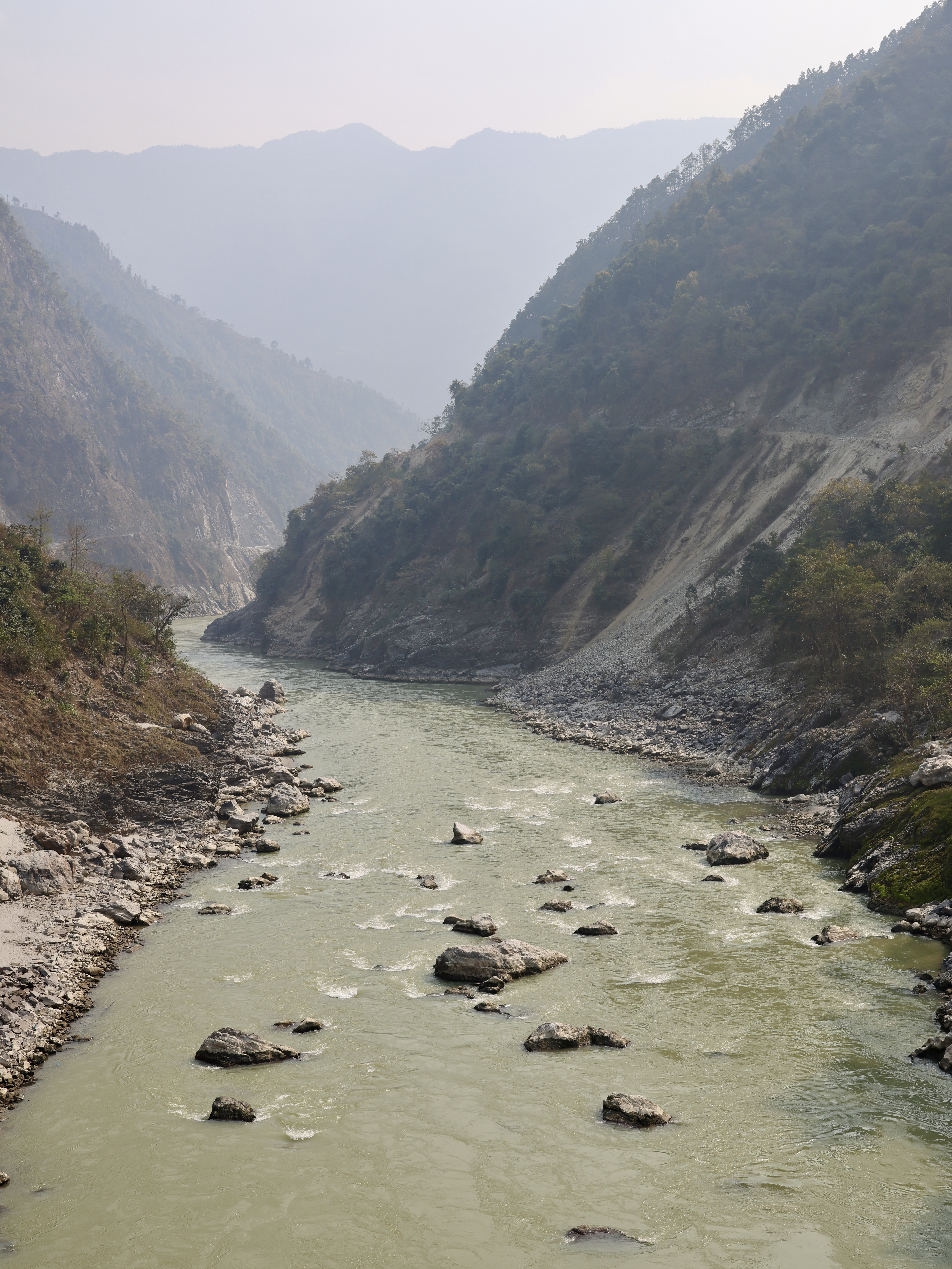
We began the descent through the forest on the steps that the roots of the trees create. We crossed paths again with the buffaloes grazing in the forest and with the beautiful ponies used to move loads and people on the mountain. However, the real descent would come later: 433 metres in 2.5 kilometres down the wall of the canyon of a river whose waters were growing until they reached Banthati 2. The deep canyon was full of images in a constant game between the rocks, vegetation and water. In some segments, walkers have built piles of stone that create a beautiful image which is effectively camouflaged in the landscape. Just at the end of the afternoon, we arrived at the set of houses that cover the narrow valley at the base of the mountain. We had just left the backpacks in a cold room and were called to see the monkeys, a colony that inhabits the cliffs of the canyon and that enjoys the last rays of light before letting themselves be hugged at night.
Our night had two flavours: on the one hand, a magnificent conversation with two young women from Hungary and with the woman from the tea house; on the other, a transition to rest in the simplicity of its facilities and the sound of the river and, finally, an icy night with an almost non-existent rest.
We started the day early, with 8 hours of road ahead. The path continues to go down; as soon as we left the town, the bells began to ring and Marce's eyes searched the forest. She could not identify anything, until there were, leaving the forest, a group of donkeys, some of them beautifully decorated, approaching with their loads: stone slabs that are produced in the area and transported to the villages. We shared the trail with them in both directions, and each encounter was a precious source of enjoyment. Again we ascended along a very steep route until we reach the top of the canyon, where the view opened and we travelled along a narrow path surrounding the mountain until we reach the Trekking Sanctuary Lodge, where the blue sky and the view of Annapurna South and the valley took our breath away and captured all our attention with a tea in hand, while the beautiful vultures of the Himalayas appeared on stage.
When continuing down the mountain, we saw a colony of Himalayan vultures, in the breeding season, and observing them gave us the impetus to continue the ascent to Tadapani. This is one of the key places on the Poon Hill circuit, full of tea houses, and allows a beautiful view of the mountain, as well as Fish Tail, another summit of beautiful shape and very difficult to photograph. Given the beauty of the place, we decided to stay and enjoy a quiet afternoon in the presence of all the elements. We enjoyed the pleasure of a hot shower, sat in the sun and ate in a simple but delicious way. With the battery recharged, Marce's curiosity was activated and she managed to coordinate with the owners of the place to teach her how to make momos. Vishnu (the mother), Subash (the son), and Deepak (the chef) guided her through the process, letting her cook from beginning to end, and an hour later we were all eating momos, which were delicious.
Unlike the other days, today's descent began slowly. We crossed the rhododendron forests to discover on their western side beautiful collections of mosses that manage to stay moist and away from the sun during the day. As it happened yesterday, the bells inside the forest began to ring, creating that feeling of warmth and mystery, and Marce's eyes began to look around, hoping to find some herd; indeed, there were the buffaloes grazing in a small section of the forest, accompanied by the chiming of their little bells.
We continued the descent until we reached the vertical section, near a small stream that descends quickly down the mountain. At the base, the route becomes smoother, with small groups of steps and areas of land that allowed us to appreciate the softness and enjoy every step with its view. In the lower lands, the singing of the birds increases, the temperature rises, and the path becomes gentle, which is delicious for our last day of walking.
We arrived at Ghandruk with enough time to explore the place. It is a village of traditional Gurung houses, the predominant ethnic group of the area, delicately cared for, with narrow alleys that descend the mountain. The houses have small gardens to grow vegetables and front patios to enjoy the landscape and the views. We managed to visit traditional tapestry weavers, two charming women who allowed us to know their place, their materials and their products. Purnima Gurung, the daughter, is an expert weaver of the tapestries of the region, and her mother, Nanda Kumari Gurung, in addition to supporting the preparation of the materials, weaves in cotton the precise textile used mainly by men as a traditional vest.
The next day, the clear sky surprised us with the white mountains as a backdrop. In addition, some visitors were enjoying the traditional costumes, and we were able to photograph them without any problem. We discovered that the road was closed and that the car could not reach the hot springs, so we changed our plans and walked to the next town to make contact with the transport. On the way to Pokhara, we took advantage of the time to visit the World Peace Pagoda, a quiet place and a structure that invites awareness and contemplation. In contrast, the temple of Sarangkot, in all its splendour, housed a festival full of colour, music and devotees visiting all the monuments of this complex; it was a feast for the senses. Additionally, we were able to enjoy traditional performing arts, with an epic representation of Shiva and Vishnu defeating the demons. We ended the day with a visit to the giant statue of Shiva and its infinite collection of Lingas.
After 9 days we returned to Kathmandu with a full heart, an enriched conscience and gratitude on the surface of the skin.
Alan y Marce
En español
El día comenzó temprano, con aire limpio y una vista más clara de las montañas; a lo lejos, picos nevados y en la cima de la montaña, nieve fresca nos acompañaban. La ruta de ascenso es larga y transcurre por un camino de piedra que entra y sale del bosque, conectando pequeñas propiedades y terrazas de cultivo. El bosque fue un verdadero placer, especialmente por su personaje principal: los rhododendron.
Este árbol puede alcanzar entre 7 y 10 metros de altura, e incluso más, con un tronco de colores rosáceos de diversas intensidades según la madurez de su corteza. Contrasta con extensas colonias de musgos y helechos que habitan en sus troncos y ramas desde una temprana edad, principalmente en el lado del árbol que no recibe la luz del sol. Sus troncos y ramas, curvos, crean formas preciosas que parecen abrazar algo, generando una atmósfera mágica y misteriosa.
Las flores son la gran atracción: una inflorescencia de colores fucsias o rojos se posa sobre una corona de hojas que caen, elevando la presencia de las flores. Los árboles, que parecen seguir la forma de la montaña, dejan ver sus copas llenas de puntos rojos sobre una alfombra verde.
En las colecciones de árboles ya florecidos, el canto de los pájaros emerge entre las hojas que se mueven y las colas de plumas que aparecen como una hoja más. Así, entramos en contacto con el hermoso Rufous Sibia, cuyos cantos llenan todo el espacio. Un poco más arriba, el camino se comparte con búfalos, y en el bosque aparecen hermosas orquídeas que crecen en las colonias de musgo de los árboles.
Después de seis horas de ascenso y ya casi sin aliento, llegamos a Gorepani, un poblado clave en la ruta, especialmente por estar a la base de uno de los miradores más hermosos de las montañas. Continuamos subiendo hasta llegar al hotel; las callecitas con escalones de piedra juegan en armonía con las casas y los muros del mismo material. Justo antes de girar a la derecha para caminar los últimos metros, allí estaba la bella montaña esperándonos para dejarse ver. Esa vista activó nuestra energía y, como si nada, subimos más escalones para optimizar la vista. Pasamos la tarde contemplando el juego de las montañas, las nubes y el viento, hasta que el atardecer nos premió con sus colores sobre las cimas, cerrando el día.
Salimos a la ruta a las 4:25 a.m., con 0 grados, para ascender a Poon Hill y apreciar Annapurna Sur y Dhaulagiri justo al amanecer. Llegamos a la cima una hora antes del amanecer, así que, además del frío, disfrutamos de todos los momentos de descubrimiento, desde la soñolienta oscuridad en el horizonte hasta la aparición plena del color, el contraste y la profundidad, maravillándonos por estar en presencia de esta belleza.
Regresamos dos horas después, descubriendo el camino y la maravillosa vista del valle, para preparar nuestra salida en dirección contraria. Ascendimos de nuevo por la montaña del este para alcanzar una altura superior a la de la mañana y disfrutar una vez más del horizonte lleno de picos nevados y nubes.
Iniciamos el descenso por el bosque a través de los escalones que las raíces de los árboles crean. Nos cruzamos de nuevo con los búfalos que pastan en el bosque y con los hermosos ponis, utilizados para mover cargas y personas en la montaña. Sin embargo, el verdadero descenso vendría después: 433 metros en 2.5 kilómetros por la pared del cañón de un río cuyas aguas fueron creciendo hasta llegar a Banthanti 2. El cañón profundo estuvo lleno de imágenes en un juego constante entre las rocas, la vegetación y el agua. En algunos segmentos, los caminantes han construido pilas de piedra que crean una imagen bella que se mimetiza efectivamente en el paisaje. Justo al final de la tarde, llegamos al conjunto de casas que cubren el estrecho valle a la base de la montaña. Solo dejamos los morrales en una habitación fría y nos llamaron a ver los monos, una colonia que habita los riscos del cañón y que disfruta de los últimos rayos de luz antes de dejarse abrazar por la noche.
Nuestra noche tuvo dos sabores: de un lado, una magnífica conversación con dos mujeres jóvenes de Hungría y con la mujer de la casa del té; del otro, una transición al descanso en la simpleza de sus instalaciones y el sonido del río y, finalmente, una noche helada con un descanso casi inexistente.
Comenzamos el día temprano, con 8 horas de camino por delante. El camino sigue en descenso; apenas dejando el poblado, las campanillas comenzaron a sonar y mis ojos buscaron en el bosque. No podría identificar nada, hasta que allí estaban, saliendo del bosque, un grupo de burros, algunos de ellos bellamente decorados, que se aproximaban con sus cargas: lajas de piedra que se producen en la zona y se transportan a los poblados. Compartimos el sendero con ellos en ambas direcciones, y cada encuentro fue una fuente preciada de disfrute. Nuevamente ascendimos por una ruta muy inclinada hasta llegar a la cima del cañón, donde se abre la vista y se transita por un sendero estrecho rodeando la montaña, hasta llegar al Trekking Sanctuary Lodge, donde el cielo azul y la vista de Annapurna Sur y del valle nos quitaron el aliento y capturaron toda nuestra atención con un té en la mano, mientras los hermosos buitres del Himalaya aparecían en escena.
Al bajar la montaña, una colonia de buitres del Himalaya se encontraba en época de cría, y observarlos nos dio el impulso para continuar el ascenso hasta Tadapani. Este es uno de los lugares clave en el circuito de Poon Hill, lleno de casas de té, y permite una vista preciosa de la montaña, así como de Fish Tail, otra cumbre de forma hermosa y muy difícil de fotografiar. Dada la belleza del lugar, decidimos quedarnos y disfrutar de una tarde tranquila en presencia de todos los elementos. Disfrutamos el placer de una ducha caliente, nos sentamos al sol y comimos de manera simple pero deliciosa. Con la batería recargada, mi curiosidad se activó y logré coordinar con los dueños del lugar para que me enseñaran a hacer momos. Vishnu (la madre), Subash (el hijo) y Deepak(el chef) me guiaron en el proceso, dejándome cocinar de principio a fin, y una hora después todos estábamos comiendo momos, que quedaron deliciosos.
A diferencia de los otros días, el descenso hoy comenzó lentamente. Atravesamos los bosques de rhododendron para descubrir en su lado occidental hermosas colecciones de musgos que logran permanecer húmedos y lejos del sol durante el día. Tal como ocurrió ayer, las campanitas dentro del bosque empezaron a sonar, creando esa sensación de calidez y misterio, y mis ojos comenzaron a buscar a su alrededor, esperando encontrar algún rebaño; efectivamente, allí estaban los búfalos pastando en una pequeña sección del bosque, acompañados del canto de sus pequeñas campanas.
Continuamos el descenso hasta llegar a la vertical, cerca de un pequeño riachuelo que desciende rápidamente por la montaña. En la base, la ruta se torna más suave, con pequeños grupos de escalones y zonas de tierra que nos permiten apreciar la suavidad y disfrutar cada paso con su vista. En las tierras más bajas, el canto de los pájaros se incrementa, la temperatura sube y el camino se vuelve amable, lo cual resulta delicioso para nuestro último día de caminata.
Llegamos a Ghandruk con tiempo suficiente para explorar el lugar. Se trata de un poblado de casas tradicionales Gurung, la etnia predominante de la zona, delicadamente cuidadas, con callejones estrechos que descienden por la montaña. Las casas cuentan con pequeños jardines para cultivar vegetales y patios frontales para disfrutar del paisaje y las vistas. Conseguimos visitar a tejedoras tradicionales de tapices, dos mujeres encantadoras que nos permitieron conocer su lugar, sus materiales y sus productos. Purnima Gurung, la hija, es una experta tejedora de los tapices de la región, y su madre, Nanda Kumari Gurung, además de apoyar la preparación de los materiales, teje en algodón el preciso textil usado principalmente por los hombres como chaleco tradicional.
Al día siguiente, el cielo despejado nos sorprendió con las montañas blancas como telón de fondo. Además, algunos visitantes estaban disfrutando de los trajes tradicionales, y pudimos fotografiarlos sin problema. Descubrimos que la carretera estaba cerrada y que el carro no podría llegar a las aguas termales, así que cambiamos nuestros planes y caminamos hasta el siguiente pueblo para hacer contacto con el transporte. En ruta hacia Pokhara, aprovechamos el tiempo para visitar la Pagoda de La Paz Mundial, un lugar silencioso y una estructura que invita a la conciencia y la contemplación. En contraste, el templo de Sarangkot, en todo su esplendor, albergaba un festival lleno de color, música y devotos visitando todos los monumentos de este complejo; fue toda una fiesta para los sentidos. Adicionalmente, pudimos disfrutar de artes escénicas tradicionales, con una épica representación de Shiva y Vishnu venciendo a los demonios. Terminamos el día con una visita a la estatua gigante de Shiva y su colección infinita de Lingas.
Luego de 9 días regresamos a Katmandú con el corazón lleno, la conciencia enriquecida y la gratitud a flor de piel.