We took the flight that would take us to Kathmandu, and after the tension of the previous 62 hours, sitting in the aircraft's seats was a relief. The first surprising image was Kathmandu from the air. While the awareness of traffic and congestion is undeniable in this city, in Marce's mind Nepal was a green and white place. Therefore, seeing from the plane this jungle of earth-coloured buildings that dominated the whole view was a great surprise.

After completing the immigration procedures and passing the inbound security inspection at customs, we were outside, beginning to understand this country. With just a few minutes of interaction, we already noticed the differences: friendly people, welcome greetings, and a general atmosphere of tranquillity which invites you to take things more calmly. We carried out the initial procedures, including, of course, having a coffee.


On our first night, we passed by a shop of handmade patches by Rah. Following his invitation, we went in to explore. This man has been embroidering patches for 35 years and showed us how he did them; we could appreciate how his mind draws the design while his hands slide the fabric to the repetitive rhythm of the needle. We left with some patches in hand and the promise of returning to pick up one of Marce's name, which he would embroider in front of me, demonstrating his mastery.

The Kingdom of Malla (from the 12th to the 18th century) was an even more prosperous period, characterised by the fragmentation of the valley into several kingdoms, each ruled by one of the King's sons. During this time, there were notable advances in the arts and architecture, with the construction of important religious and administrative facilities. The disputes between the different Malla kingdoms also fostered an atmosphere of competition that boosted artistic development.
In the 18th century, the Kingdom of Gorkha, under the leadership of King Prithvi Narayan Shah, unified the Kathmandu Valley, creating the Kingdom of Nepal, which was key in the defence of the territory and lasted until 2008, when the monarchy was abolished and the Federal Democratic Republic of Nepal was established.

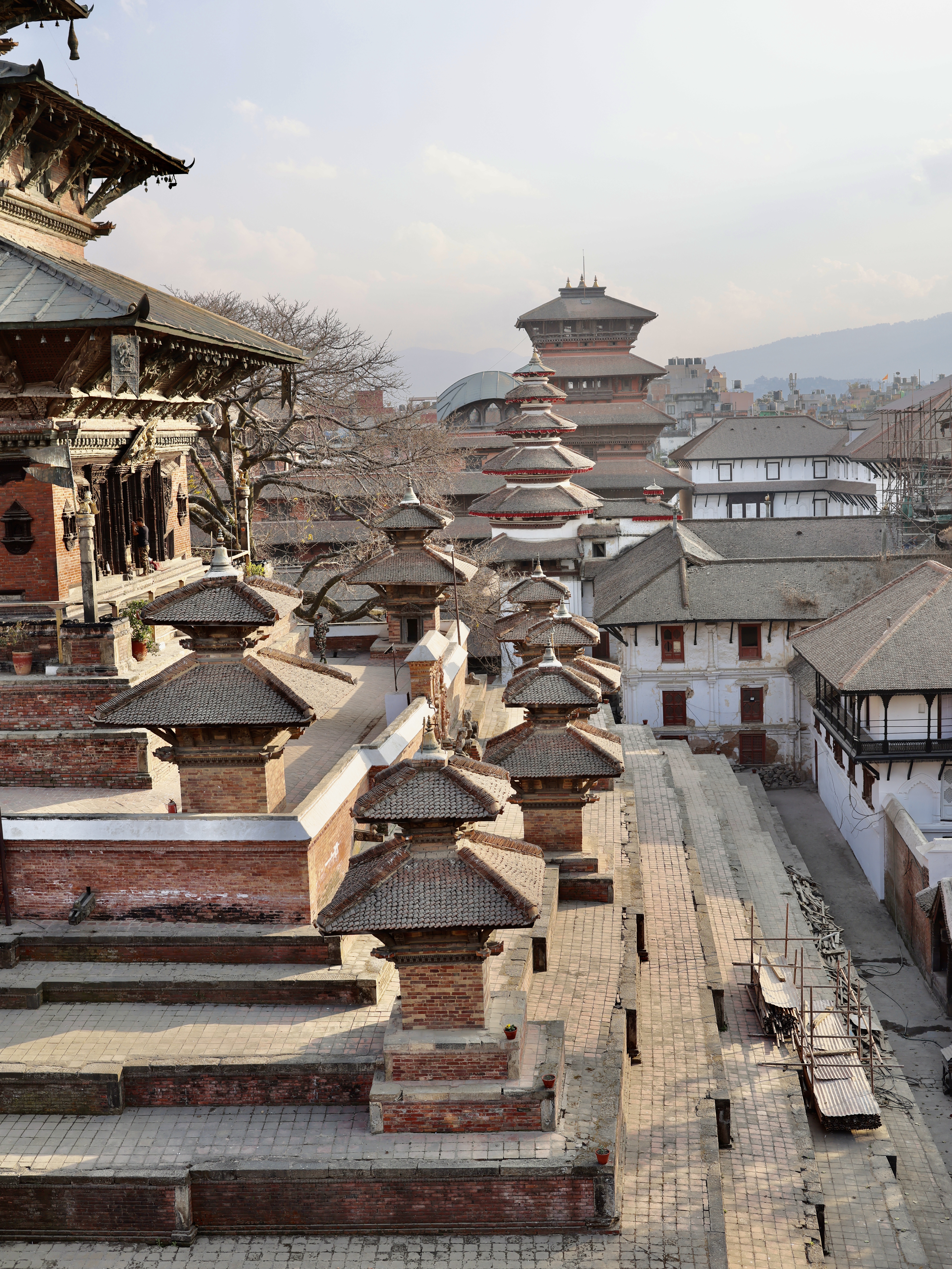
Kathmandu has multiple representations of this cultural wealth, among which Kathmandu Darbar Square and Patan Darbar Square stand out. Both reflect the richness of Newar architecture, which flourished during the Malla empire. This architecture is characterised by the distinctive use of materials such as carved wood and brick. The buildings, often adorned with intricate carvings representing deities and mythological scenes, have pagoda-shaped roofs with multiple levels, which brings both aesthetic beauty and functionality. In addition, the inclusion of courtyards and open spaces encourages social and ritual interaction in the community.

The temples and mandapas, which serve as meeting places, reflect the integration of Hinduism and Buddhism, while the frescos and decorative reliefs narrate the rich history and traditions of the Newar culture.


Complementing the scene are the Nepalese stupas, which clearly represent the Buddhist presence in the country. To the west is the Stupa of Swayambhunath, also known as the Temple of the Monkeys, which dates back to the 5th century CE and is located on a hill with panoramic views of the city. It is famous for its large golden dome and its Buddha eyes that look in the four directions, symbolising vigilance and wisdom. It is also known for the Hindu temple that shares the same territory and for the monkeys, specifically the Rhesus macaque, which are considered sacred. These monkeys live in the place, turning the sunset into a whole party with their intense movements, games, and jumps. In addition, their ability to take advantage of the food offered by humans has led to the tea being served with a broomstick to scare away the monkeys.


To the east of the city is the Boudhanath Stupa, one of the largest in the world and an important Buddhist pilgrimage centre. Recognised for its immense mandala and unique architectural style, Boudhanath is a site of devotion and cultural activity in which, every day, devotees make circuits (kora) at its base, to demonstrate their devotion, practise active meditation, gain merits for their spiritual evolution, and strengthen their community ties.

In the interweaving of religions and traditions, we find the figure of the Kumari, a venerated girl considered a living goddess in Nepal, specifically in the Kathmandu valley. The Kumari represents the incarnation of the Hindu goddess Taleju. This tradition dates back to the Malla dynasty in the 12th century CE, when the king, inspired by a dream, established this figure. The selection of the Kumari is a rigorous process which involves identifying a girl of Newar origin who meets 32 auspicious characteristics. Her life as Kumari involves residing in the Kumari Ghar in Kathmandu, where she is worshipped and protected. During her term, she participates in important religious and ceremonial festivals, where she receives the reverence of the devotees.
The Kumari will maintain her role until she reaches puberty, at which time it is considered that she loses the powers of the goddess with the arrival of menstruation, thus ending her cycle as a living goddess. We were surprised that this tradition is still in force; initially we thought people were referring to stories from the past, but this is not the case. Today, there are three main Kumari who come from different families and are under the care of a special group, in addition to eleven Kumari who participate in ceremonial activities and festivities, living with their original families.


Another prominent element in the panorama of the valley is Thangka painting, a traditional form of Tibetan and Nepalese art which is characterised by its meticulous technique and deep religious symbolism. These paintings, usually made on cotton or silk canvas, are used as teaching tools in Buddhist traditions, providing detailed images of deities, mandalas, and accounts of sacred texts. They are made with paints obtained from minerals, and natural dyes, and are often embellished with gold leaf, which gives them a special glitter. Around the city, it is possible to get lost among mandalas and attention-captivating glances. We also had the opportunity to enjoy some contemporary art exhibitions and explore new expressions and forms that weave the present in Nepal.
Our days in Kathmandu were endless walks through streets and alleys that go up and down, and that reveal to us in the blink of an eye small surprises, unexpected events, and unplanned conversations, nourishing our steps and leaving a satisfying flavour of the experience.
Alan y Marce
En español
Tomamos el vuelo que nos llevaría a Katmandú, y después de la tensión de las últimas 62 horas, sentarnos en la silla del avión fue todo un alivio. La primera imagen sorprendente fue Katmandú desde el aire. Si bien la fama del tráfico y la congestión es innegable en esta ciudad, en mi mente, Nepal era un lugar verde y blanco. Por ello, ver desde el avión esta selva de edificaciones de color terroso que dominaba toda la vista fue una gran sorpresa.
Después de completar los trámites de migración y pasar la inspección de seguridad en la aduana, estábamos afuera, comenzando a entender este país. Con solo unos minutos de interacción, ya notábamos las diferencias: gente amable, saludos de bienvenida y un ambiente general de calma que invita a tomarse las cosas con más tranquilidad. Realizamos los trámites iniciales, incluyendo, por supuesto, tomar un café.
Llegamos al hostal justo al final del día. Una habitación relativamente amplia, con balcón, dos sillas y una pequeña mesa, nos recibió. Nos alojamos en Thamel, el vibrante corazón turístico de Katmandú, conocido por sus calles estrechas y llenas de tiendas coloridas de artesanía, ropa y artículos para trekking, así como agencias de turismo. Su ambiente bohemio ofrece una mezcla única de cultura nepalí y cafés del mundo que resulta muy tentadora para nosotros.
En nuestra primera noche, pasamos por una tienda de parches hechos a mano por Rah. Siguiendo su invitación, entramos a explorar. Este hombre lleva 35 años bordando parches y nos enseñó cómo los hacía; pudimos apreciar cómo su mente dibuja mientras sus manos deslizan la tela al ritmo repetitivo de la aguja. Salimos con algunos parches en la mano y la promesa de regresar a recoger mi nombre, que bordaría frente a mí, demostrando su maestría.
El valle de Katmandú ha sido habitado desde tiempos antiguos, pero fue a partir del siglo III que el valle asumió un rol protagónico con los reinos Licchavi, Malla y finalmente el Reino de Gorkha.
Durante el período Licchavi (aproximadamente del siglo III al VII d.C.), el valle se destacó por su floreciente comercio, siendo un punto clave en la ruta transhimalaya, gracias a la armonía religiosa, la forma de gobierno y la arquitectura.
El Reino de Malla (del siglo XII al XVIII) fue un período aún más próspero, caracterizado por la fragmentación del valle en varios reinos, cada uno gobernado por uno de los hijos del rey. Durante este tiempo, se produjeron avances notables en las artes y la arquitectura, con la construcción de importantes instalaciones religiosas y administrativas. Las disputas entre los diferentes reinos Malla también fomentaron un ambiente de competencia que impulsó el desarrollo artístico.
En el siglo XVIII, el Reino de Gorkha, bajo el liderazgo del rey Prithvi Narayan Shah, unificó el valle de Katmandú, creando el Reino de Nepal, que fue clave en la defensa del territorio y perduró hasta 2008, cuando se abolió la monarquía y se dio paso a la República democrática federal de Nepal. Katmandú cuenta con múltiples representaciones de esta riqueza cultural, entre las que destacan Katmandú Durbar Square y Patan Durbar Square. En ambas se refleja la riqueza de la arquitectura Newar, que floreció durante el imperio Malla. Esta arquitectura se caracteriza por el uso distintivo de materiales como la madera tallada y el ladrillo. Los edificios, a menudo adornados con intrincadas tallas que representan deidades y escenas mitológicas, presentan techos en forma de pagoda con múltiples niveles, lo que aporta tanto belleza estética como funcionalidad. Además, la inclusión de patios y espacios abiertos fomenta la interacción social y ritual en la comunidad.
Los templos y mandapas, que sirven como lugares de reunión, reflejan la integración del hinduismo y el budismo, mientras que los frescos y relieves decorativos narran la rica historia y las tradiciones de la cultura Newar.
Complementando la escena, están las estupas nepalíes, que representan con claridad la presencia budista en el país. Hacia el occidente se encuentra la Estupa de Swayambhunath, también conocida como el Templo de los Monos, que data del siglo V d.C. y se sitúa en una colina con vistas panorámicas de la ciudad. Es famosa por su gran cúpula dorada y sus ojos de Buda que miran en las cuatro direcciones, simbolizando vigilancia y sabiduría. También es conocida por el templo hindú que comparte el mismo territorio y por los monos, específicamente el **Macaca mulatta**, que son considerados sagrados. Estos monos habitan en el lugar, convirtiendo el atardecer en toda una fiesta con sus movimientos intensos, juegos y saltos. Además, su capacidad para aprovechar la comida que les ofrecen los humanos ha llevado a que el té se sirva con un palo de escoba para espantar a los monos.
Al oriente de la ciudad se encuentra la Estupa de Boudhanath, una de las más grandes del mundo y un importante centro de peregrinación budista. Reconocida por su inmenso mandala y su estilo arquitectónico único, Boudhanath es un sitio de devoción y actividad cultural en el que, todos los días, los devotos realizan circunvalaciones (kora) en su base, para demostrar su devoción, practicar meditación activa, hacerse méritos para su evolución espiritual y fortalecer sus lazos comunitarios.
En el tejido de religiones y tradiciones, encontramos la figura de la Kumari, una niña venerada considerada una diosa viviente en Nepal, específicamente en el valle de Katmandú. La Kumari representa la encarnación de la diosa hindú Taleju. Su tradición se remonta a la dinastía Malla en el siglo XII, cuando el rey, inspirado por un sueño, estableció esta figura. La selección de la Kumari es un proceso riguroso que implica identificar a una niña de origen Newar que cumpla con 32 características auspiciosas. Su vida como Kumari implica residir en el Kumari Ghar en Katmandú, donde es adorada y protegida. Durante su mandato, participa en importantes festivales religiosos y ceremoniales, donde recibe la reverencia de los devotos.
La Kumari mantendrá su papel hasta que alcance la pubertad, momento en el cual se considera que pierde los poderes de la diosa con la llegada de la menstruación, finalizando así su ciclo como diosa viviente. Nos sorprendió que esta tradición sigue vigente; inicialmente pensamos que se referían a historias del pasado, pero no es así. Hoy en día, hay tres principales Kumari que provienen de diversas familias y están bajo el cuidado de un grupo especial, además de once Kumari que participan en actividades ceremoniales y festividades, viviendo con sus familias originales.
Otro elemento destacado en el panorama del valle son las pinturas Thangka, una forma tradicional de arte tibetano y nepalí que se caracteriza por su técnica minuciosa y su profundo simbolismo religioso. Estas pinturas, generalmente elaboradas en lienzo de algodón o seda, se utilizan como herramientas de enseñanza en las tradiciones budistas, proporcionando imágenes detalladas de deidades, mandalas y relatos de textos sagrados. Se elaboran con pinturas obtenidas de minerales y tintes naturales, y a menudo se embellecen con hoja de oro, lo que les otorga un brillo especial. Alrededor de la ciudad, es posible perderse entre mándalas y miradas que cautivan la atención. También tuvimos la oportunidad de disfrutar de algunas exhibiciones de arte contemporáneo y explorar nuevas expresiones y formas que tejen el presente de Nepal.
Nuestros días en Katmandú fueron caminatas interminables por calles y callejuelas que suben y bajan, y que nos revelan en cada abrir y cerrar de ojos pequeñas sorpresas, eventos inesperados y conversaciones no planeadas, nutriendo nuestros pasos y dejando un sabor satisfactorio de la experiencia.
Alan y Marce


No comments:
Post a Comment